The Combined Edition
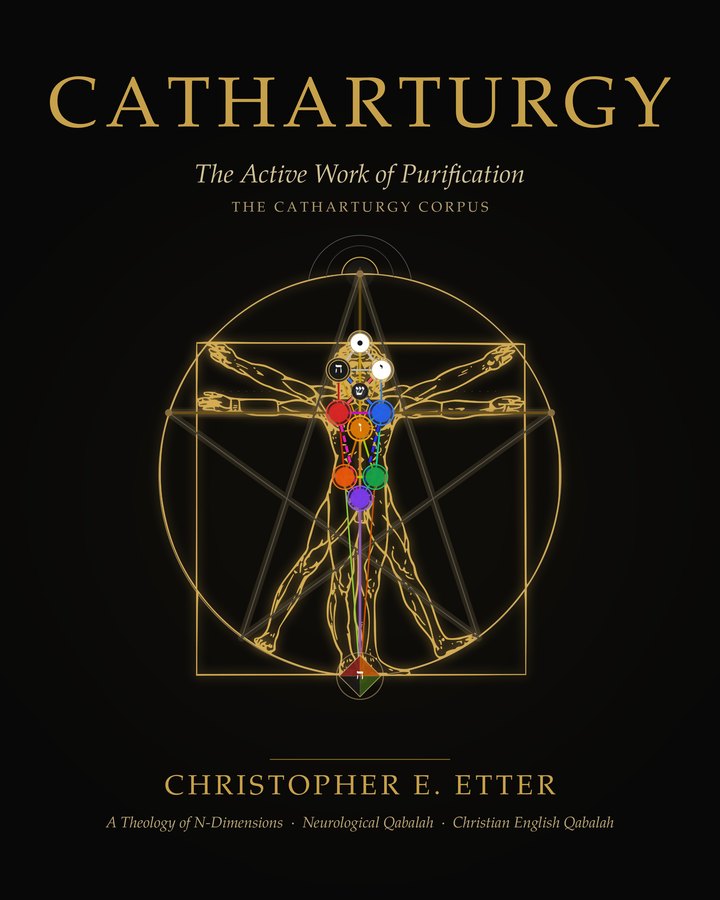
- Title
- Catharturgy: The Active Work of Purification
- Contents
- The first three volumes of the Corpus in three Books, with a new general introduction
- Length
- 666 pages · 90 chapters · 30 plates
- Format
- 8 × 10 in · colour print and EPUB
- Author
- Christopher E. Etter
Nothing can limit God but itself. From that axiom, Christopher E. Etter's Catharturgy Corpus builds a philosophical theology, follows it into the living nervous system, and turns it into a practice of purification. This edition gathers the Corpus's first three volumes in a single book of 90 chapters, thirty plates, and a new general introduction.
Book One, A Theology of N-Dimensions, sets out the frame. Its system, Kenotic Effluent Panapotheism, reads creation as three moments of one act: God's withdrawal from a point, which leaves the three-dimensional space of the world as its evidence; the outpouring of the divine light into that space; and a cosmos that is from God, within God's imprint, and never God's essence. The Book gives the relation between God, the soul, and the world a perpendicular geometry, reads the dimensions and the regular solids as forms of divine self-limitation, and sets the theology in dialogue with Buddhist thought and with Maximus the Confessor.
Book Two, Neurological Qabalah, carries the frame into its substrate. It lays the Tree of Life over the brain's great networks, reads its ten stations as the intelligences of the Sefer Yetzirah, reads the planets and signs as modes of the mind, and follows the soul from the autonomic kingdoms to the governance of the will.
Book Three, Christian English Qabalah, makes the whole a map and a practice: twenty-six English letter-paths and the four hidden river paths, ten virtues seated on the Tree's stations, the elemental balances, the Observation Principle by which the mind's projections are watched without fear, and the offices of the soul.
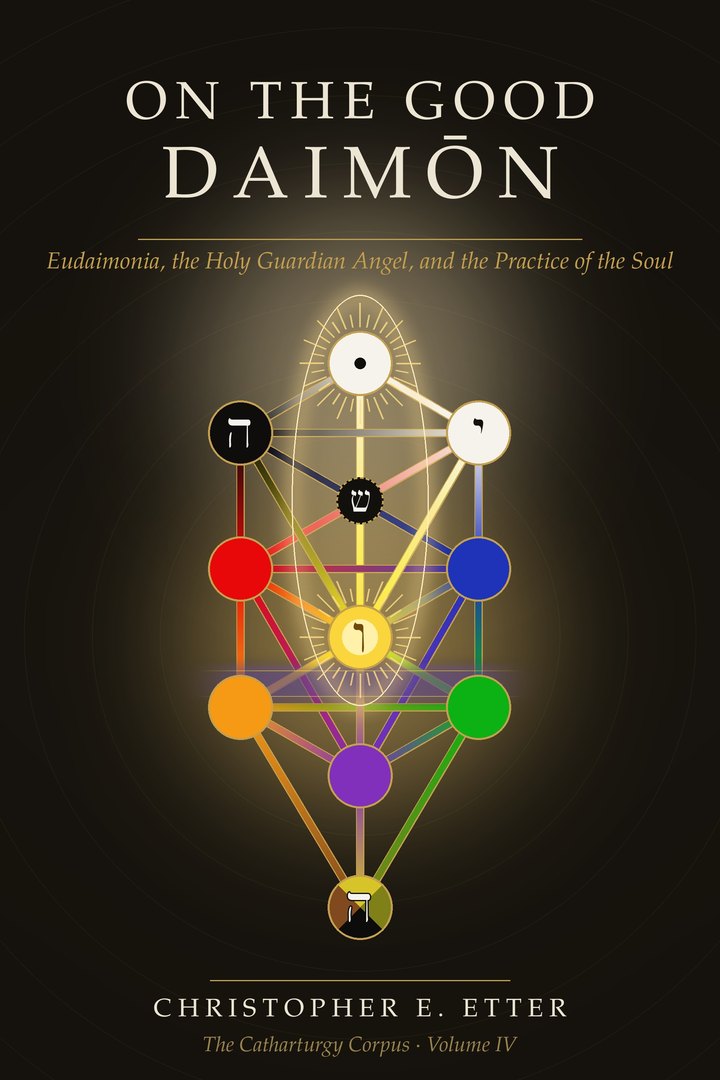
Every claim is graded between what the sources and the sciences establish and what the work proposes. The fourth volume of the Corpus, On the Good Daimōn, devoted to the Holy Guardian Angel and the practice of the work, is published separately.
Three Books in 779 pages of text, after 48 pages of front matter: half-title, series page, title, copyright, On the Assistance of the Machine, A Personal Note, contents, thirty plates in a section of their own, and the General Introduction.
The same biographies as the series' publishing copy, so every book describes you alike.
| Book | Pages | Parts, with their chapters |
|---|---|---|
| Book One · A Theology of N-Dimensions | 1–194 | Before the Axiom (1–4) · The Axiom and the Act (5–16) · Perpendicular Ontology (17–21) · The Ground Beneath (22–27) · Time, Freedom, and the Higher Register (28–29) · The Pattern and the Method (30–31) · The Descent Through the Stack (32–35) · The Dialogical Frontier (36–37) |
| Book Two · Neurological Qabalah | 195–436 | The Core Architecture (38–44) · The Sefer Yetzirah Intelligences (45–54) · The Whole Brain (55–56) · The Heavens (57–58) · Soul and Brain (59–61) |
| Book Three · Christian English Qabalah | 437–619 | Before the Letters (62–64) · The Paths and the Virtues (65–71) · The Elemental Balances (72–82) · The Disorders Read on the Tree (83–88) · The Offices of the Soul (89–90) |
The Four Volumes
Volume I · A Theology of N-Dimensions
-
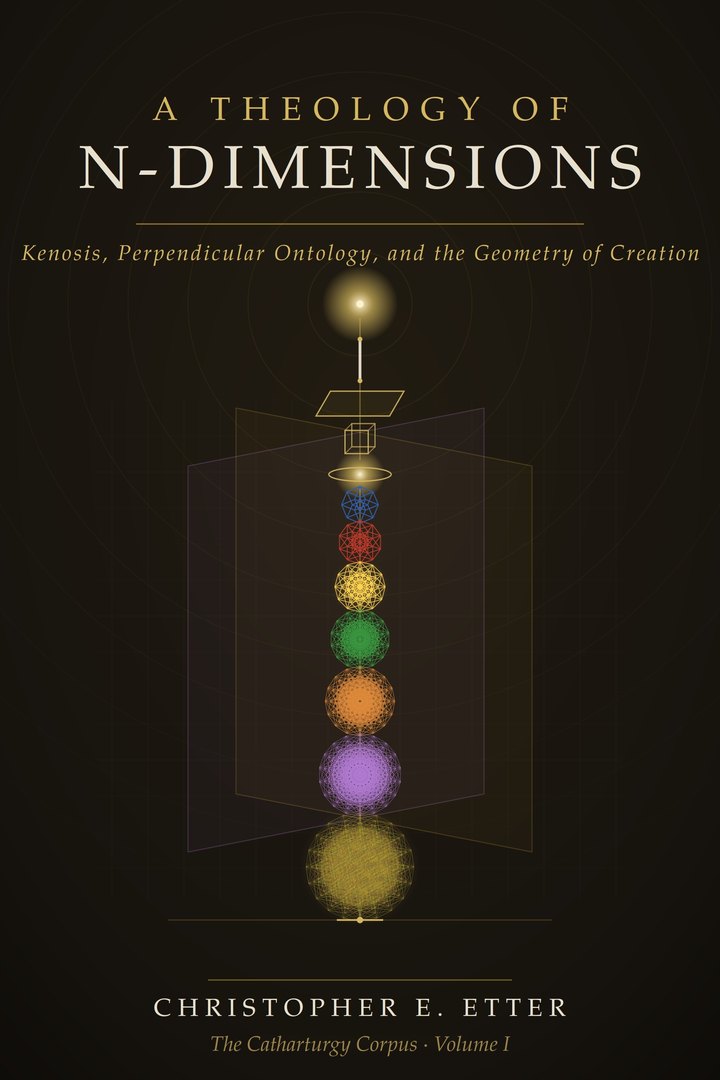
A Theology of N-Dimensions
The volume · Volume I
Kenosis, Perpendicular Ontology, and the Geometry of Creation. 555 pages, 86 chapters, with its cover, parts, and plates.
-
The Kenosis Is Strict
The universal definition of the kenotic act
-
In Is Up
Implosion, two postures, one threshold
-
The Ladder Inverted
The point, the frame, the Bang, the totality
The governing declaration of the volume, with its plate: the full thirteen-line catechism from Ein Sof to the intersection, the crest of the wave at Geburah, the cap, and the honesty ledger of the inversion.
-
The Critical Dimension
T-duality, tachyons, perpendicularity
T-duality, the renormalization-group critical dimension, and tachyon condensation in bosonic string theory, read through ontological perpendicularity — eight claims sorted across four tiers: Found, Evidenced, Open, and Constructed. Interactive.
-
The Significance of Twenty-Six
Found constants, one construction
Eight appearances of the number 26 — the Tetragrammaton, Genesis 1:26, the cube, Fermat's Sandwich Theorem, bosonic string theory, the precession of the equinoxes, the English alphabet, and the CEQ's 26 paths — sorted honestly into found-exact, found-approximate, and constructed. Interactive.
-
The Significance of Thirty-Six
Found constants, two constructions
Eight appearances of the number 36 — the triangular root of 666, the Magic Square of the Sun, the 36 Egyptian decans, the Talmud's Lamed-Vav Tzadikim, and Hanukkah's 36 candles — alongside this Corpus's own Sephiroth-plus-paths and bosonic-plus-superstring bridges, sorted honestly into found and constructed. Interactive.
-
Primality as Monadic Form
The primes as forms of the One
The prime numbers as irreducible instances of the One — an interactive map of the symbolic primes from 1 through 23.
-
The Perpendicular Frame
Two, the prime of the right angle
The frame of space itself, governed by primes — the hypercube as 2 to the d, the primality of dimension, and the thresholds by which primes enter higher space.
-
The Perpendicular Dualisms
Privation and balance, at right angles
Twelve classical dualisms sorted onto two perpendicular axes — hierarchical privation running vertically, complementary balance running horizontally. Interactive.
-
The Polyhedral Forms
The five solids, made of 2·3·5
The five regular solids as a closed system of the first three primes — every face, count, and symmetry built of 2, 3, and 5, with 7 excluded.
-
The Dimensional Monads
The Monad and twelve prime monads
The Monad and the first twelve prime monads as thirteen dimensions — the cumulative sums landing on the decad, the perfect number, and the decad squared at the soul's boundary.
-
The Elemental Hierarchy
The nine choirs and four worlds
The nine angelic choirs in three triads, mapped to the four worlds and the four elements, with the human soul at the foot.
-
The Geometry of N Dimensions
Completely orthogonal — after Sommerville
-
The Essentials of Dimensional Geometry
Six plates, from point to the heights
A six-plate primer: the progression of dimensions, slices and shadows, the hypercube family, the census of perfect shapes, the three eternal families, and the strangeness of high dimensions.
-
The Vanishing Measure
Where measure peaks, dies, and the count is capped
-
The Vitruvian Sphere and Cube
The figure in three dimensions
The Vitruvian figure raised into 3D: sphere and cube in golden proportion, the Tree upon the body, quarter pentagrams, six rose crosses, and the Supernal triangle lifted above the cube. Drag to rotate.
-
Three Persons, One Figure
Wuji, Taiji, and the Trinity
The taiji read as the Trinity upon a single figure: the Limitless Ground, the Crown, and the two serpents of Logos and Spirit — one center, one form.
-
The Spiral of the Year
The zodiacal sphere through time
Earth and Sun upon the celestial sphere with time as the vertical axis: Kepler’s true orbit, the tropical zodiac on the Ecliptic, and the year as a spiral that ends 0.239° short of closure. Animated.
-
The Projection of Gravity
The dimensional graph of a fall
A real 1000-meter fall graphed in distance, time, and velocity: the curved worldline on the plane and the straight paths above it meeting at 140 m/s — the dimensional account of gravity, drawn. Animated.
-
The Tesseract of Time
A cube imploding over time
The perspective tesseract produced, never imported: a cube shrinking through time traces the 4-cube’s thirty-two edges exactly, and the twenty-six expands to eighty. Animated.
-
The Six Axes
The compact dimensions at the particle
Two tangent spheres, six axes as chords, and the compact dimensions X⁵–X¹⁰ of string theory toured one by one at the particle — until the point becomes a hinge and Metatron’s Cube unfolds below. Animated, interactive.
Volume II · Neurological Qabalah
-
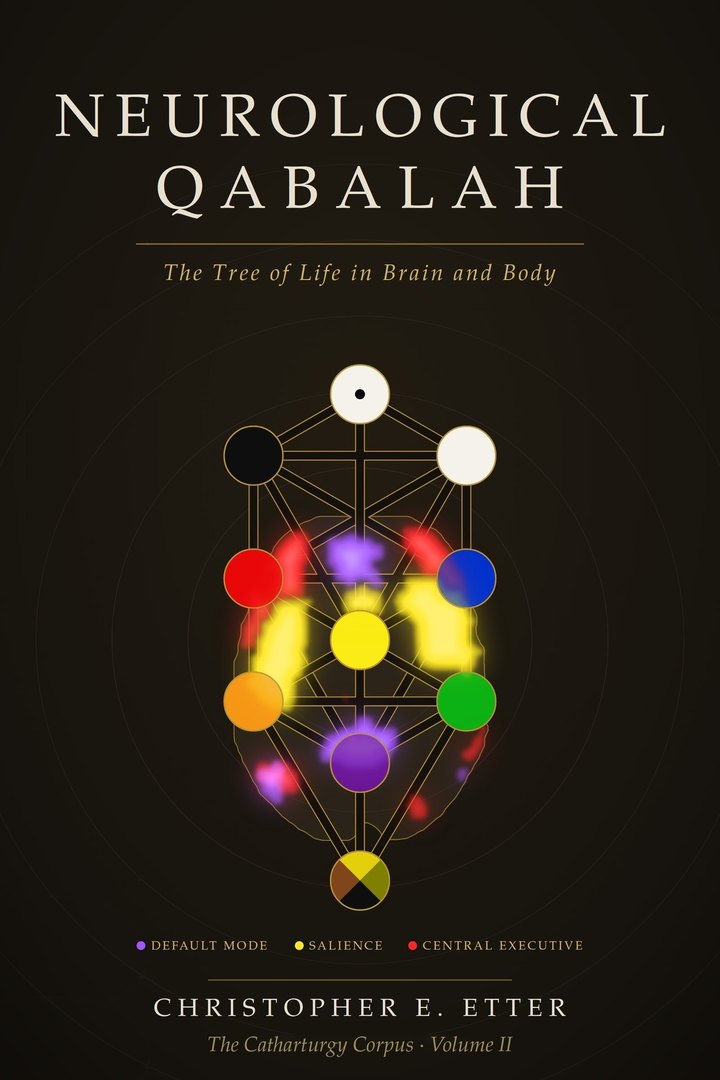
Neurological Qabalah
The volume · Volume II
The Tree of Life in Brain and Body. 555 pages, 47 chapters, with its cover, parts, and plates.
-
The Neurological Qabalah
The Tree, neuro-first
The Sephiroth, the 26 Paths, and the CEQ Letters combined into one Tree of Life, with the neurological substrate of every node and path leading each click. Interactive.
-
The Triple Network Model
Executive, Salience, Default Mode
Menon's Triple Network Model — the Central Executive, Salience, and Default Mode networks — mapped onto this Corpus's own Tree, with the brain-overlaid-on-Tree images for each network and the overview diagram. Interactive.
-
The Seven Soul Registers
Yechidah to Nefesh
The seven levels of the soul, from the unitary spark of Yechidah down to the animal vitality of Nefesh, mapped to the Tree and the brain.
-
The Three Pillars
Mercy, Severity, and the Middle
The three pillars of the Tree — Mercy, Severity, and the reconciling Middle Pillar — and the brain-hemisphere structure they encode.
-
The Five Elements
Fire, Air, Water, Earth, Spirit
The five elements and their correspondences — the four classical elements gathered under the fifth, Spirit, the quintessence.
-
The Four Hidden Rivers
Pishon, Gihon, Hiddekel, Euphrates
The four rivers of Eden as the four hidden paths of the Tree, each a neuromodulatory current of the brain.
-
The Major Arcana
The tarot of the 26 paths
A tarot deck of the Tree's twenty-six paths. Each card is a zoomed-in view of a single path — the two Sephiroth it joins curving in as half-circles, the path itself the gradient between them. In progress.
-
The Disorders Map
The inverted-U of regulation
The disorders of the soul as failures of regulation along the inverted-U, each a sphere or path fallen into excess or deficiency.
Volume III · Christian English Qabalah
-
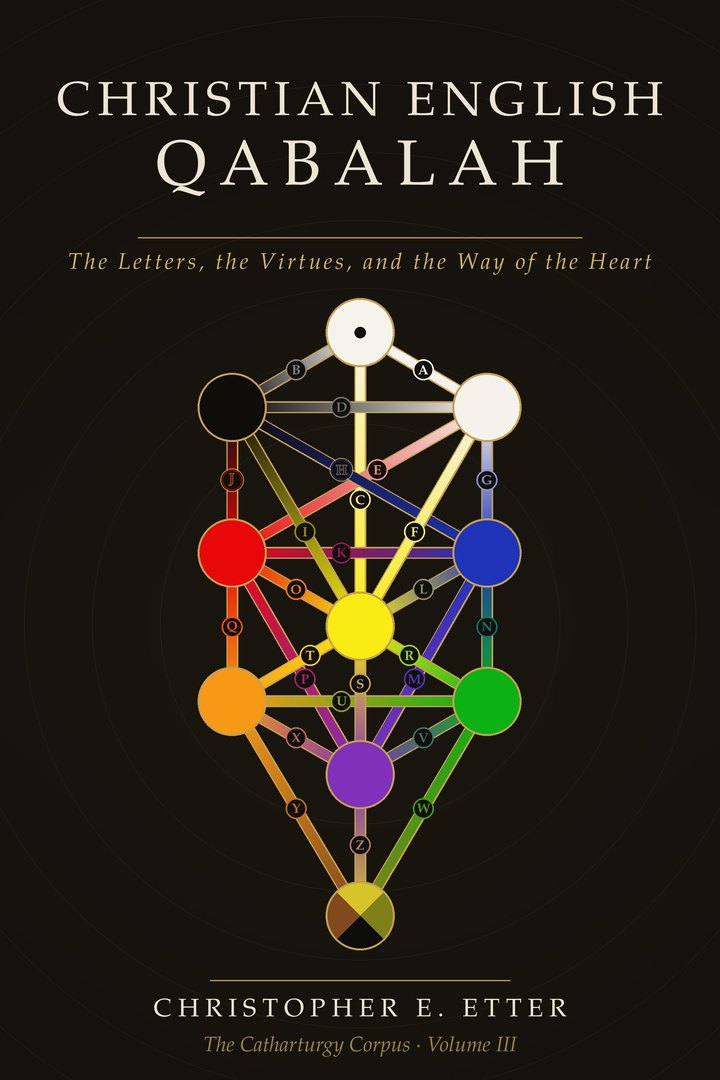
Christian English Qabalah
The volume · Volume III
The Letters, the Virtues, and the Way of the Heart. 555 pages, 74 chapters, with its cover, parts, and plates.
-
The Twenty-Six Letters
The Christian English Qabalah
The twenty-six letters of the Christian English Qabalah, each with its value, sphere, and place on the Tree.
-
The Twenty-Six Paths
Letters, signs, and rivers
The twenty-six paths of the Tree — the twenty-two letters and the four hidden rivers — each with its connection, color, and correspondence.
-
The Sephiroth
Ten spheres of the Tree
The master table of the Cathartes Scale: each sphere a brain region, soul-level, pillar, color, musical note, virtue, and divine name.
-
The Closed Spectrum
Color as the whole-brain carrier
An interactive meditation on color as the carrier of the Tree — no letters, no symbols, only the closed spectrum of visible light. Watch the spectrum lay flat, the descent from the Monad unfold, the primaries return to white, and the closed sphere-scale give way to the scattered traditional path colors. Interactive.
-
The Cathartes Keyboard
Color and tone, 36 keys
An interactive keyboard from G2 to F♯5, centered on middle C — each key carrying its note and the color of the Cathartes Scale.
-
The Vitruvian Soul
The Tree in the figure of man
An interactive Tree of Life mapped onto the sacred geometry of the human form — circle, pentagram, cross of Tau, and Vitruvian square. The ten Sephiroth, the hidden Daath, the three Veils, and the four quarters of Malkuth, each clickable, with toggleable geometric layers. Interactive.
-
The Ten Virtues
The virtue of each sphere
The virtue and the privation of each of the ten spheres, in the colors of the Cathartes Scale.
-
The Gravity of Yesod
Event horizon, Samekh, Middle Pillar
Yesod is the source of gravity on the Tree. The Path of Samekh — Hebrew for "to prop" — descends as temptation and ascends as the cure. Sadness, desire, and addiction as three orbital positions around the Yesodic event horizon. The Middle Pillar reconstructed. Interactive.
-
The Weight of the Ego
Four witnesses, one gravitational principle
Four independent witnesses across five thousand years — the Feather of Ma'at, Dante's gravitational Hell, Augustine's incurvatus in se, and the Dark Factor of personality — converge on a single claim: the self curved inward acquires weight, the weight produces descent, and the descent ends in privation. Catharturgy is the constructive corollary. Interactive.